

From Horses to ETFs: Why Better Structures Win (Quietly, Then Completely)
If you had to commute into work today, there is a chance you cycled, a chance you used public transport, but most likely, you drove your own vehicle. One thing we can say with near certainty is that you did not ride a horse to work. Yet just over a century ago, many people were absolutely convinced that the horse would never be replaced.
The lesson for modern investing is simple: incumbent tools feel permanent, until they do not.
Today, the same pattern is repeating as trillions flow out of traditional mutual funds and into ETFs, a structural shift as profound as the move from horse drawn transport to the automobile. And just as yesterday’s sceptics insisted the horse would outlast the car, many industry voices once insisted the mutual fund would forever dominate.
But history, and flows, tell a different story.
“The horse is here to stay”: How incumbents dismissed the future
Skepticism toward the automobile wasn’t fringe, it was the mainstream view among those closest to the incumbent technology. In 1900, The Washington Post quoted a seasoned Washington horse dealer insisting that automobiles were “nothing but a fad” and would never seriously affect the horse market.
A few years later, a California farmer wrote to the Pacific Rural Press, arguing that automobiles were unreliable, costly, dangerous, and fundamentally inferior, concluding “they are a fad… and will go out.”
Even investors doubted the shift. A 1922 biography recounts an unnamed banker advising Henry Ford’s lawyer, Horace Rackham, not to invest because: “The horse is here to stay, but the automobile is only a novelty, a fad.”
Automobile pioneer Alexander Winton recalled being ridiculed as “the fool who is fiddling with a buggy that will run without being hitched to a horse.”
It is almost comical in hindsight. But this kind of resistance to new, structurally superior technology is the norm, not the exception.
The same story in finance: Mutual funds face their own “horse moment”
Fast‑forward a century. The modern mutual fund turned 100 recently, and the Financial Times marked the milestone with a blunt question:
“The mutual fund at 100: is it becoming obsolete?”
Their reporting highlighted a tidal shift:
- More than $1 trillion in mutual‑fund outflows between 2021 and 2023.
- Over $2 trillion in ETF inflows over the same period, including $575 billion in 2023 alone.
- Investors moving en masse toward structures offering lower fees, greater tax efficiency, and real‑time liquidity.
Morningstar’s long‑time research director John Rekenthaler was even more direct:
“I don’t see what a mutual fund can do better than an ETF. It’s a better mousetrap. Eventually the mutual fund is dead.”
Flows don’t lie: Investors have already voted
ETFs aren’t just growing, they’re dominating inflows across asset classes.
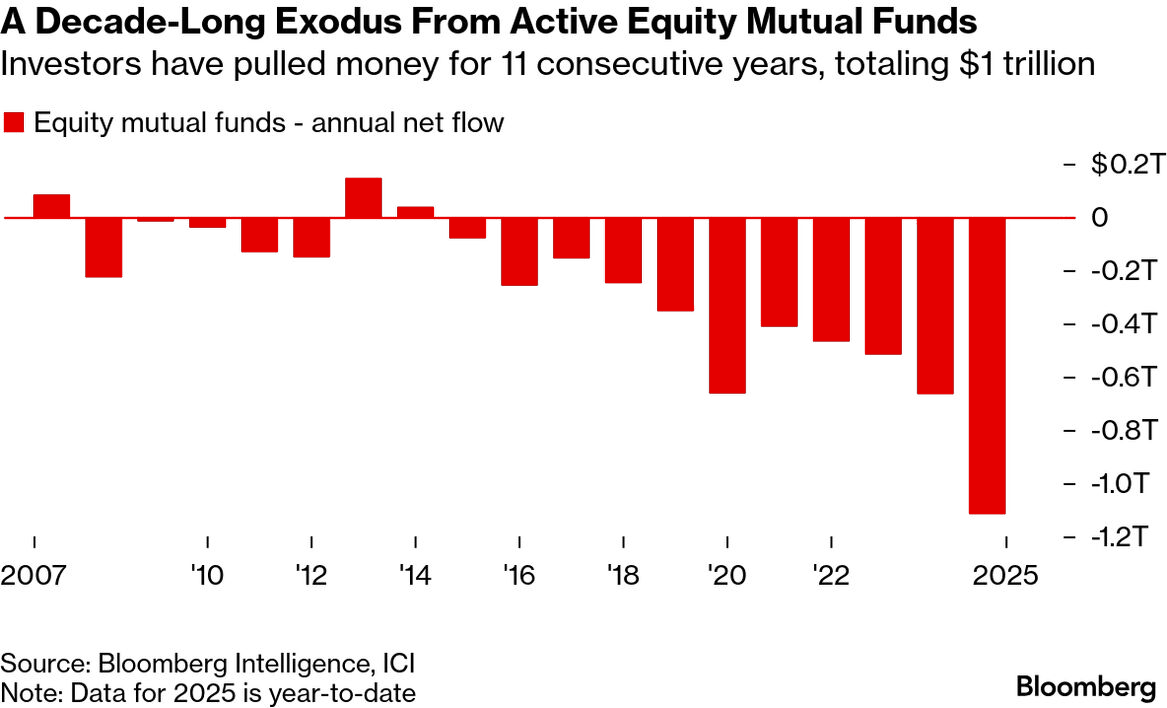
A recent article by Bloomberg Intelligence noted that we have seen a multi decade long exodus from active equity mutual funds, with the pace of outflows increasing each year and reaching a record in 2025.
Meanwhile, according to data from FactSet Research revealing that 2025 saw a record ETF net issuance of $1.49 trillion, with total US listed ETF assets exceeding $13.5 trillion at year end.
Morningstar’s 2024 review declared it a “banner year for ETFs”, with ETFs now accounting for about one‑third of the total U.S. fund market, up from just 5% in 2004.
Regulators see the same picture. The SEC’s Registered Fund Statistics show ETFs steadily expanding both in number and share of industry assets, marking a systemic, not cyclical, shift.
In short: investors aren’t predicting a future, they’re already living in it.
Why ETFs replaced mutual funds: The structural superiority is clear
- Tax efficiency
The in‑kind creation/redemption mechanism dramatically reduces capital‑gains distributions, a telling structural advantage that most mutual funds simply cannot match. This was a major driver of the 2021–2024 conversion wave.
- Intraday liquidity
Mutual funds price once per day. ETFs trade all day at market prices, critical for advisers, institutions, and model‑portfolio platforms.
- Lower costs and fee pressure
Persistent index‑fund fee competition has pushed ETF pricing down. Investors have responded with trillions in inflows to low‑fee ETF exposures.
- Performance realities
SPIVA’s long‑term scorecards repeatedly show the majority of active managers underperform their benchmarks over time, making mutual funds structurally hard to justify. The last US SPIVA update found 87% of U.S. large‑cap funds underperformed the S&P 500 over the past 5 years.
- Product innovation
ETFs now span bonds, factors, thematics, options overlays, defined‑outcome structures, and more, all while maintaining transparency and tradability.
Conclusion: You don’t need to predict the future, the flows already have
Technological adoption doesn’t follow a straight line; it follows an S‑curve. Slow at first, then accelerating rapidly when the new solution becomes good enough, familiar enough, and cost‑effective enough.
This was the pattern when automobiles went from 5% to 80% penetration between 1910 and 1930.
And it is the pattern we are living through in fund structures:
- ETF adoption has passed the early‑adopter phase
- Advisors increasingly use ETF‑based models
- Mutual‑fund‑to‑ETF conversions are accelerating
- Tax‑sensitive investors overwhelmingly prefer ETFs
- Passive ETF assets continue to grow faster than active mutual funds
Like the horse, mutual funds may persist in niche roles but their era as the default structure has already ended.
Great article Matt , well done in making it fun and factual !
Sorry , I see Dave was the author – well done .